In off-road rescue, stamped pulleys are often referred to as "force multipliers". This seemingly simple mechanical device can double the effect of limited winch tension, providing critical additional power when the vehicle is in a desperate situation. Understanding the principle and application of snatch blocks is a compulsory course for upgrading ordinary rescue to professional rescue.
The core function of snatch blocks
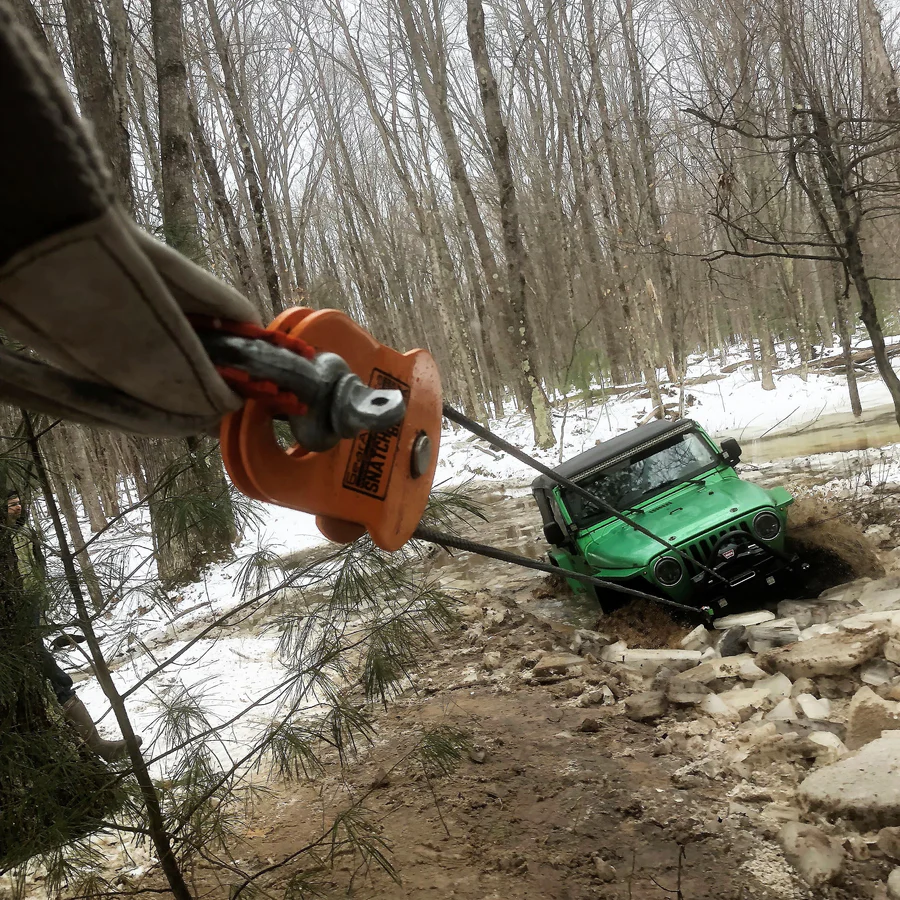
The core value of snatch blocks in off-road rescue lies in changing the direction of force and increasing traction. When the winch cable is connected to the trapped vehicle through a stamped pulley fixed to the anchor point and then turned back, a simple dynamic stamped pulley system is formed, which theoretically can double the traction force. A more complex snatch block system configuration allows for the use of existing equipment to cope with more severe stuck situations without replacing larger winches.
Selection of key equipment
The off-road rescue snatch block must have high strength and low friction characteristics. The main body is usually forged from alloy steel or processed with aviation aluminum, and equipped with ball bearings or sliding bearings inside to ensure smooth rotation under several tons of tension. The snatch block side plate needs to be able to open and close, making it easy to install without cutting the cable. Its nominal working load must be greater than 1.5 times the maximum tension of the winch, with sufficient safety redundancy.
The high-strength release buckle and anchor strap used in conjunction with the snatch block are equally crucial. The snatch block is connected to the anchor point through a shackle, and the strength of all connecting components must match that of the snatch block. Tree ties or ground anchors provide reliable fixing points to ensure the stability of the snatch block system foundation.
Typical configuration of snatch block system
Single force system: changing direction
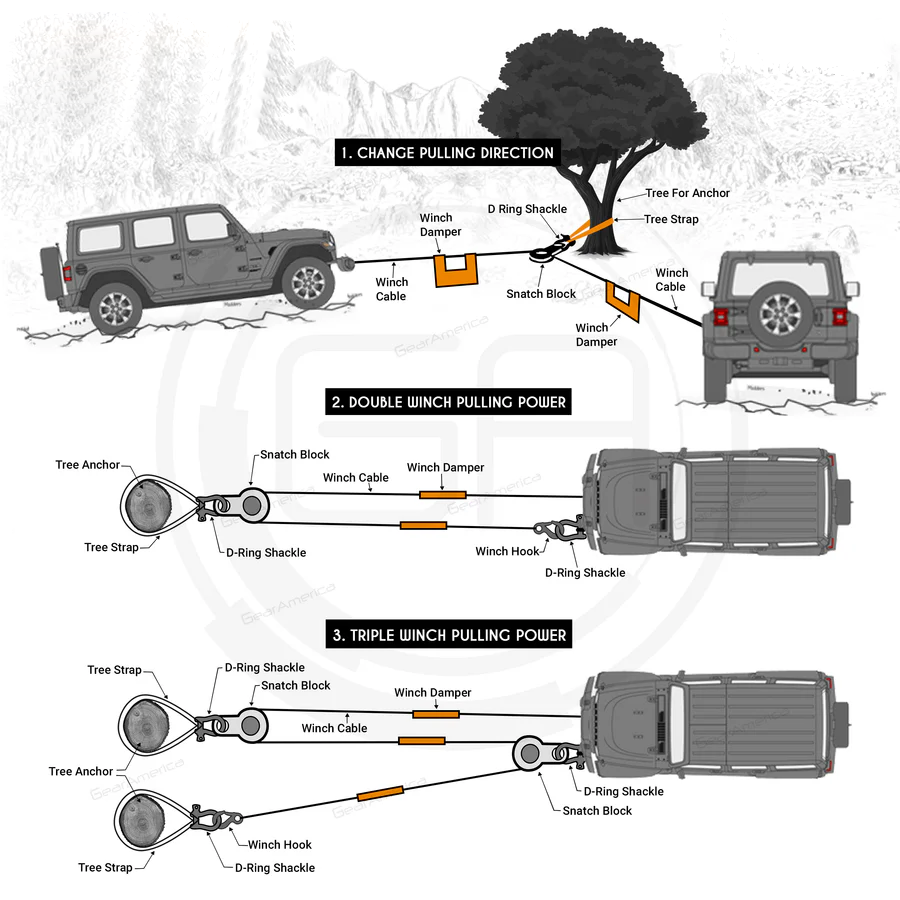
When the vehicle is stuck in a narrow ditch and the rescue vehicle cannot pull in a straight line, the punching pulley can be fixed on the side tree or rock, and the winch cable can be connected to the trapped vehicle after passing through the punching pulley. At this point, the pulling force remains unchanged, but the direction of traction can be flexibly adjusted to allow the rescue vehicle to stop and operate on a solid road surface.
Double force system: increase tension
This is the most common snatch block efficiency configuration. Fix the snatch block at a remote point (such as a big tree), and the winch cable passes through the snatch block before turning back and connecting to the trapped vehicle. When the winch is working, the actual pulling force that the vehicle bears is about twice the nominal pulling force of the winch (ignoring friction losses). This configuration is suitable for situations where the vehicle is deeply immersed and the required pulling force exceeds the capacity of the winch alone.
Triple force and above system: Extreme escape
By combining multiple snatch blocks, a more complex compound snatch block system can be formed. For example, fixing two snatch blocks to anchor points and vehicles respectively, and repeatedly winding the cable back and forth, theoretically can obtain three or even four times the pulling force. However, it should be noted that the higher the multiplier, the slower the cable winding speed, and the greater the friction loss, resulting in an actual gain lower than the theoretical value.
Operation process and key steps
Step 1: Anchor evaluation and selection
The force of the snatch block system ultimately acts on the anchor point. It is necessary to ensure that the anchor point can withstand loads several times greater than the tension of the winch. Live trees need to be protected with tree ties, rocks need to be checked for looseness, and vehicles used as anchor points need to shift into parking gear and tighten the handbrake. The anchor position should be aligned with the traction direction to avoid lateral force.
Step 2: Installation and connection of snatch block
Secure the snatch block firmly to the anchor point, ensuring that its side plate is fully closed and the locking pin is in place. The winch cable should be correctly inserted into the stamped pulley groove without twisting or crossing. The end of the cable is connected to a sturdy anchor point (beam or dedicated trailer hook) of the trapped vehicle through a shackle.
Step 3: Cable Management and Damping
All cable segments that are threaded must be kept neat and avoid friction with each other. Cover the cable with a damping bag or heavy clothing, and the covering point should be selected on the straight section of the cable to ensure effective buffering even if it breaks. All personnel must evacuate outside the danger zone.
Step 4: Smooth application of force and monitoring
The winch operator tightens the cable at a constant speed, and the trapped driver lightly steps on the accelerator to cooperate. Observe whether the snatch block operates smoothly and whether the anchor point is displaced. If you hear abnormal noise from the snatch block or see abnormal wear on the cable, stop immediately and recheck and adjust.
Step 5: System Release and Recycling
After escaping, the snatch block system needs to be released in a no-load state. Maintain control when releasing the cable to prevent the snatch block from suddenly falling. Check all cables and stamped pulleys for wear and deformation, clean the mud and properly store them.
The Iron Law of Safety and Common Misconceptions
The snatch block system amplifies both the force and the risk. The strength of all connecting components must match that of the stamped pulley, and using a low strength shackle is a fatal mistake. When the snatch block is under force, the areas on both sides are equally dangerous and no one should approach it. When threading cables, be sure to wear thick gloves to prevent burrs and cuts on the cables.
A common misconception is to hang the snatch block directly on an unprotected tree trunk, which not only harms the environment but also causes anchor failure due to the sliding of the bark. Another misconception is to ignore the matching between the cable and the stamped pulley groove, as cables that are too thick or too thin can cause jamming or increased wear during operation.
Applicable scenarios of snatch block system
snatch blocks are most suitable for single vehicle winch self rescue scenarios - without a second rescue vehicle, relying solely on its own winch to deal with stuck vehicles far beyond the capacity of a single machine. It is also suitable for adjusting complex terrain angles, allowing the winch to apply force from the optimal mechanical angle. On low adhesion surfaces such as swamps and snowy terrain, the snatch block system can prevent the rescue vehicle from getting stuck and complete the traction with a remote anchor point.
Conclusion
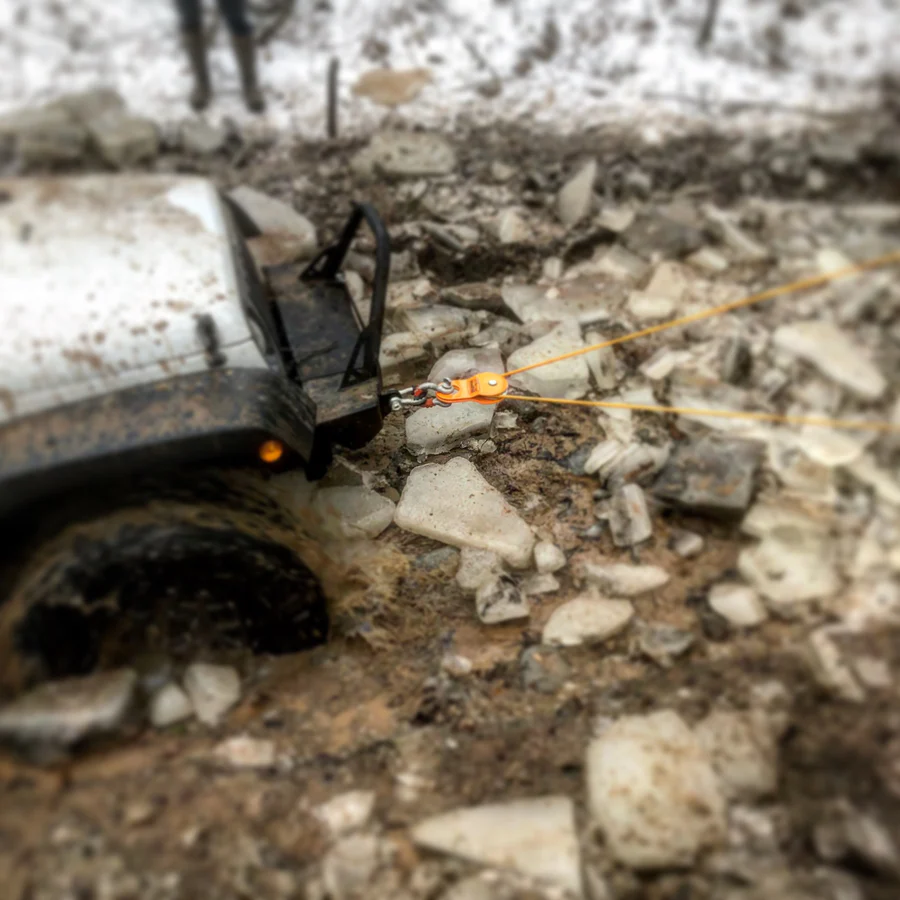
snatch blocks are levers used in off-road rescue, allowing limited equipment to generate excessive force. But the double-edged nature of this power is equally evident - it tests the user's judgment, connectivity skills, and respect for physical laws. Mastering the use of snatch blocks proficiently means that you have gained a sense of composure and confidence in the face of extreme difficulties. Every successful escape through the snatch block system is a vivid interpretation of mechanical principles and rescue wisdom.


