Equipment And Operation for Desert Rescue Vehicles
Views: 689 Author: Thinkwell Publish Time: 2026-03-24 Origin: Site
The charm of desert off-road lies in its vastness and freedom, while the challenge lies in the sand never compromising. When the wheels get stuck in soft sand, every spin only deepens the dilemma. The particularity of desert rescue lies in the fact that rescue vehicles also face the risk of getting stuck.
First reaction to getting stuck in a car: Stop digging sand
When the wheels slip, immediately release the accelerator and stop the vehicle. Continuing to press the accelerator will only sink deeper and deeper. Get off the car and observe: How deep are the wheels stuck? Has it been backed up? These judgments determine the subsequent plan.
Core Equipment List
Trailer strap: low ductility, length 9-15 meters. Trailers with excessive elasticity in the desert can cause vehicles to jump, which is actually detrimental
Shackle: forged alloy steel D-type shackle, matched with trailer strap for working load
Escape board: at least two pieces, with gripping teeth on the surface
Inflator pump and tire pressure gauge: tire pressure regulation is the core skill of desert driving
Long handled shovel: a necessary tool for cleaning floating sand
Tree holding strap: used for winch anchor or traction extension
Self rescue priority
Reducing tire pressure is the most effective way to escape from the desert. Reduce the tire pressure to 0.8-1.0, significantly increase the tire contact area, and make the vehicle "float" on the sand surface. After getting out of trouble, use an inflation pump to restore the tire pressure on the road.
Use a shovel to clean the floating sand within two meters in front of the tire, and insert the escape plate into the front of the tire at a slight angle. Engage low-speed four-wheel drive, select second gear for starting, lightly press the accelerator to accelerate smoothly. Once there is a forward trend, keep the throttle stable.
Car to car rescue
The rescue vehicle must be parked on a solid sand surface, and the tire pressure should also be reduced to prevent self sinking.
Connect the trailer strap to the original trailer hook or beam anchor point of both vehicles using a shackle. Hang a prominent damping material in the center of the trailer belt - this is the key to preventing breakage and rebound. All personnel should stay away from the danger zones on both sides of the trailer.
The rescue vehicle is attached to low-speed four-wheel drive, and after the towing belt is slightly straightened, it applies continuous and steady force. The trapped car lightly stepped on the accelerator to cooperate. Desert rescue should avoid sudden impacts, as sudden impacts can easily cause the rescue vehicle to sink or the connection point to fail.
Winch rescue
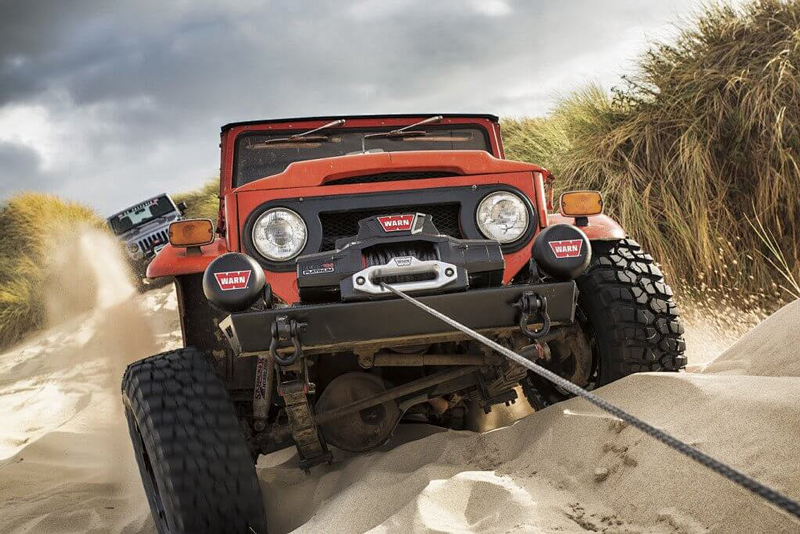
When there is no rescue vehicle, the winch is the last resort. Search for shrubs or dead wood roots, wrap them with tree ties, and connect the winch. If there is no vegetation, use sand anchors to bury at least 1 meter deep. The winch cable is connected to the anchor point of the main beam, covered with damping material, and operated at a constant speed outside the vehicle using a remote control. The trapped car lightly stepped on the accelerator to cooperate.
Post rescue inspection
After getting out of the predicament, check whether the trailer straps and shackles are damaged, and clean the dust on the equipment. Use an inflation pump to restore tire pressure to 2.0-2.5.