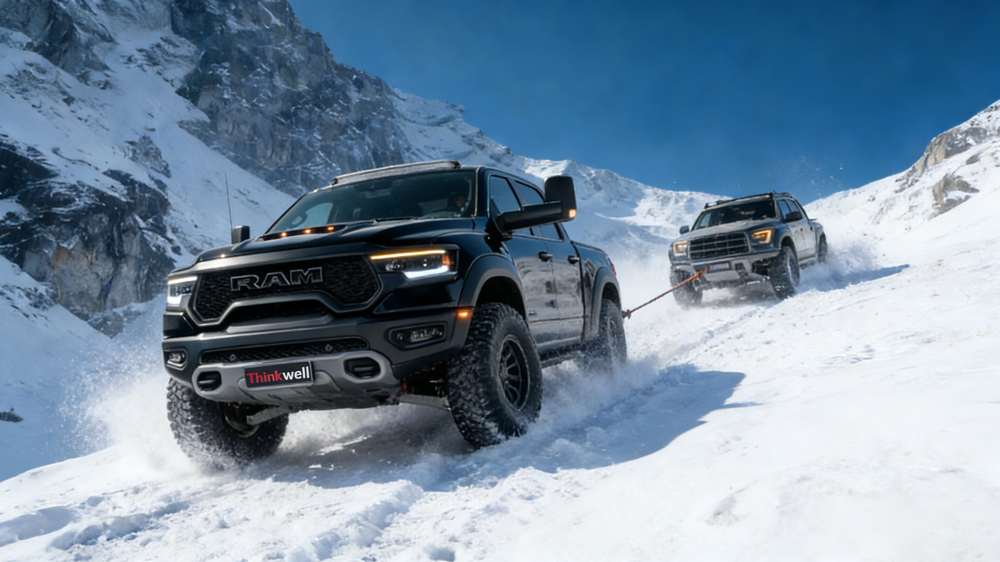
Guide to Traction and Rescue on Ice and Snow Roads
Views: 689 Author: Thinkwell Publish Time: 2026-03-04 Origin: Site
When the wheels get stuck in snow and the car body spins helplessly on the ice, snow rescue becomes a special challenge in a race against low temperatures, slippery conditions, and time. The world covered in ice and snow may seem peaceful, but it hides more complex rescue challenges than mud - extremely low friction coefficients, difficult to determine hidden obstacles, and the dual test of equipment and human body caused by severe cold.
**The particularity of snow rescue**
There is a fundamental difference between snow rescue and conventional off-road rescue. Snow may cover deep trenches, tree stumps, or rocks, and rescue vehicles also face the risk of getting stuck when approaching. The low temperature makes the trailer strap harder and the metal connectors more brittle, while the trailer hook under ice and snow cover may be difficult to detect or have frozen. More importantly, trapped vehicles are often not truly "stuck", but unable to start due to a lack of grip - which determines that the core of rescue strategies should be "creating grip" rather than simply "applying tension".
**Selection of core rescue equipment**
**Snow specific trailer belts must have low-temperature adaptability. High quality products use special synthetic fibers that can maintain flexibility even at minus 30 degrees Celsius, avoiding low-temperature brittleness. It is recommended to have a length of at least 9 meters to ensure sufficient safety distance for rescue vehicles. Choose eye-catching orange red or bright yellow colors for easy recognition against a white snow background.
**Special attention should be paid to thread antifreeze when using D-type shackles in snow. Before use, check whether there are ice crystals in the thread, and if necessary, use hot water to melt or special anti freezing spray treatment. After connection, be sure to tighten it completely, as metal shrinkage at low temperatures may cause the connection to loosen.
**Skateboards and snow tracks are magical tools for snow self rescue. The anti slip plate surface designed specifically for snow is equipped with higher protrusions or metal teeth, which can penetrate and compact snow layers or even ice surfaces to provide adhesion. Some products can be spliced together to form temporary snow tracks. In deep snow areas, * * snow escape boards * * (similar to elongated and widened snowshoes) can be directly fixed under the tires, providing buoyancy and grip.
**Portable snow shovel is irreplaceable. Aluminum alloy material is lightweight and not easily frozen, with serrated sides that can cut through hard snow or ice layers. Clearing the snow before and after the tires is the first step in any snow rescue and often directly solves the problem.
**The winch and snow anchor play a crucial role when there is no rescue vehicle available. **Snow anchor (also known as ice anchor) is a spiral shaped metal device that can be screwed into ice or deep snow, and can provide a reliable anchor point when buried deep enough. **When using the tree hugging belt, it is necessary to clean the snow around the trunk to ensure a solid contact surface.
**Environmental assessment before rescue**
After arriving at the scene, the primary task is to assess the snow conditions and hidden risks. The depth, density (powder snow or wet heavy snow), and presence of ice layers at the bottom determine the rescue strategy. Use a probe or long handled tool to explore around the tire and confirm if there are any hidden obstacles. Observe the terrain slope and traction direction, and prioritize dragging in a downhill or flat direction.
**The selection of the location for the rescue vehicle is crucial. It must be stopped on a solid road surface or compacted snow layer to avoid getting stuck. If necessary, the snow around the tires of the rescue vehicle can be cleared first, or a skid plate can be placed under the tires to increase the starting adhesion. Maintain a straight traction angle between the two vehicles to avoid lateral forces.
**Personnel protection in low-temperature environments**
Snow rescue may last for a long time, and all personnel must be prepared for the cold. Wear windproof and waterproof jacket, warm middle layer, snow boots, windproof gloves and goggles. Prepare hot water, high calorie food, and spare dry clothing. Put electronic devices such as mobile phones and walkie talkies in the inner pocket for insulation to prevent the battery from quickly depleting at low temperatures.
Establish a rotation mechanism to prevent anyone from being exposed to extreme cold for a long time. Observe whether your companions show signs of hypothermia (shivering, unclear speech, slow response), and immediately stop outdoor activities and enter the vehicle for heating if they do.
**Conclusion**
Snow rescue is a gentle game against the forces of nature. It is not as intense as mud rescue, but it tests patience and delicacy. Every successful escape stems from respect for the laws of ice and snow, trust in equipment performance, and the ability to think clearly even in the cold. When the wheels regain grip on the solid ground and the trapped vehicle slowly exits the snow pit, the warmth of completing the challenge together in the icy and snowy world is enough to withstand any severe cold.